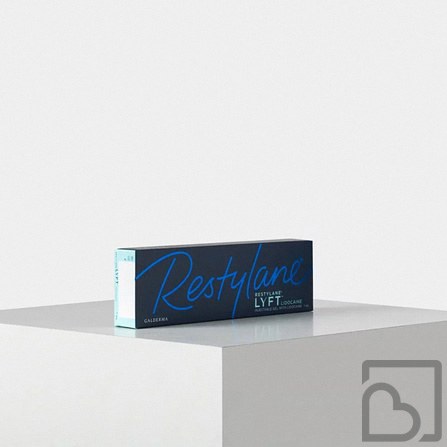
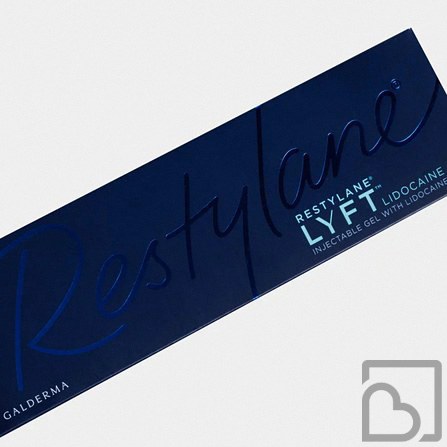
Restylane Lyft with Lidocaine is a high-density hyaluronic acid filler designed for deep tissue support, structural volumization, and contour refinement.
Formulated with NASHA™ technology, it has a firm, cohesive gel consistency that provides reliable lift and projection, making it ideal for cheeks, midface volume restoration, chin enhancement, and jawline definition.
The strong lifting capacity of Restylane Lyft allows precise shaping while maintaining natural transitions between treated and untreated areas.With 0.3% lidocaine, injections are more comfortable for the patient, and results typically last 10-12 months, depending on technique, anatomy, and metabolism.
Rheological properties / Product data
HA concentration: 20 mg/ml
Cross-linking agent: BDDE
Elasticity (G′): High
Cohesivity: High
Texture: Firm NASHA™ gel
Lidocaine content: 0.3%
Syringe volume: 1 ml
Injection depth & tools
Recommended depth:
Deep dermis
Subcutaneous layer
Supraperiosteal plane
Injection techniques:
Bolus
Linear threading
Micro-bolus for contour shaping
Recommended instruments:
27G needle (included)
25G cannula for advanced contouring
Inject slowly, with aspiration where appropriate, under strict aseptic conditions. Suitable only for practitioners trained in deep-plane HA filler techniques.
Storage & handling
Store at 2 °C - 25 °C, away from heat and sunlight
Do not freeze
Single-use syringe - discard after opening
Do not reuse needles or cannulas
Dispose of all materials according to local medical waste guidelines
For use exclusively by licensed medical professionals trained in dermal filler injection techniques. Not intended for self-administration or non-medical cosmetic use.
Avoid alcohol for 24 hours before and after treatment to reduce the risk of bruising and swelling.
Contraindicated during pregnancy. There are no adequate studies on the safety of dermal fillers in pregnant women.
Use is not recommended during breastfeeding due to insufficient data on the excretion of filler components into breast milk.
Each syringe contains 1 ml of cross-linked hyaluronic acid (20 mg/ml) with lidocaine 0.3% for patient comfort and reduced injection pain.
Inject into the deep dermis or subcutaneous layer using a needle or cannula, depending on the anatomical site. Injection technique may include linear threading, fanning, or small bolus placement. Always aspirate before injection and administer slowly. Maintain strict aseptic conditions throughout the procedure.
Typical post-injection reactions include mild redness, swelling, bruising, tenderness, or itching, which usually resolve within a few days. Rare complications such as vascular occlusion, nodules, infection, or asymmetry require immediate medical attention.
The cross-linked hyaluronic acid provides mechanical lift and restores lost tissue volume by attracting and retaining water molecules. It integrates into the dermal matrix, supporting facial contours and improving elasticity while maintaining natural facial movement.