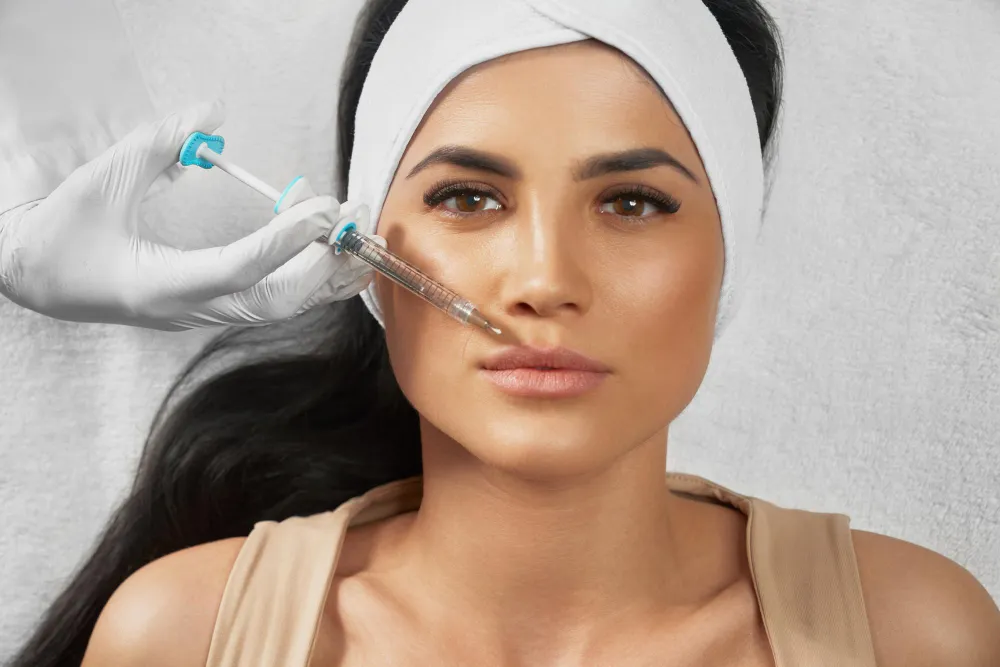





Stylage and Saypha are hyaluronic acid–based dermal filler brands commonly used for facial volume restoration, contouring, and wrinkle correction. While both rely on stabilized HA, their formulation technologies and tissue behavior differ in clinically relevant ways.
This comparison helps clarify when to choose a firmer, contour-focused HA filler versus a smoother formulation designed for subtle integration.
Brand Overview and Origin
Stylage
Stylage is a French dermal filler line formulated with hyaluronic acid stabilized using IPN-Like Technology (Interpenetrated Network). Many Stylage products also contain mannitol, an antioxidant added to reduce oxidative stress and post-injection swelling.
Commonly used variants include Stylage Bi-Soft L Lidocaine, Stylage Bi-Soft XL Lidocaine, and Stylage Bi-Soft Special Lips Lidocaine. This formulation philosophy positions Stylage as a filler family suited for defined contouring and structural shaping.
Saypha
Saypha is an Austrian filler brand manufactured using the SMART technology platform, designed to produce smooth, cohesive HA gels with predictable integration and elasticity.
Frequently selected products include Saypha Volume Lidocaine, Saypha Volume Plus Lidocaine, and Saypha Filler Lidocaine. In contrast, Saypha prioritizes smooth integration and softness, making it suitable for subtle volume correction.
Hyaluronic Acid Technology
Stylage fillers are designed to maintain flexibility while providing structure, with mannitol helping to slow HA degradation.
- IPN-Like crosslinking
- antioxidant support via mannitol
- balanced elasticity and projection
Saypha focuses on gel homogeneity and smooth extrusion.
- SMART crosslinking technology
- high cohesivity with soft integration
- predictable tissue response
Clinically, Stylage provides slightly firmer projection, while Saypha offers a softer, more homogeneous tissue response.
Texture, Handling, and Injection Feel
From an injector’s perspective:
- Stylage offers slightly firmer projection in higher G′ variants
- Saypha tends to feel smoother and softer during injection
Stylage may be preferred for sculpting and definition, while Saypha is often chosen for blending and natural transitions. In practice, Stylage is selected when sculpting and definition are priorities, whereas Saypha is chosen for blending and natural transitions.
Longevity and Tissue Integration
Both brands offer comparable longevity depending on formulation and placement.
- Stylage: approximately 9–18 months
- Saypha: approximately 9–15 months
Longevity depends on treatment area, depth, and patient metabolism. Stylage’s broader longevity range reflects its firmer gel options, while Saypha prioritizes softness over extended persistence.
Indications and Treatment Areas
Stylage is frequently selected for:
- midface volume restoration
- cheek and jawline contouring
- lip shaping with defined borders
Stylage may be less suitable for patients seeking very soft, low-projection results.
Saypha is commonly used for:
- soft facial volume correction
- nasolabial and marionette lines
- patients seeking subtle enhancement
Saypha may be less appropriate when strong structural contouring is required.
Safety and Reversibility
Both Stylage and Saypha are hyaluronic acid fillers and can be dissolved with hyaluronidase if needed.
This reversibility supports staged correction and conservative planning, particularly in sensitive facial zones.
Stylage vs Saypha: Key Differences
- Stylage includes antioxidant mannitol
- Saypha emphasizes gel smoothness and homogeneity
- Stylage offers slightly firmer contouring options
- Saypha excels in natural blending and softness
Stylage is better suited for firmer contouring and definition. Saypha is preferred for smooth blending and subtle enhancement.
Related Resources on Unboxed Fillers
Stylage and Saypha are both reliable HA filler systems, with selection guided by desired texture, projection, and injector preference rather than performance alone.
For more professional insights, explore additional comparison articles on Unboxed Fillers.
FAQ: Stylage vs Saypha
What is the main difference between Stylage and Saypha?
The main difference lies in gel behavior and formulation philosophy. Stylage emphasizes firmer projection and sculpting through IPN-like crosslinking and antioxidant support, while Saypha focuses on smooth, cohesive gels designed for subtle integration and softness.
Which filler is firmer: Stylage or Saypha?
Stylage is generally considered firmer, especially in higher G′ formulations, making it more suitable for contouring and defined facial shaping.
Which filler is better for subtle and natural-looking results?
Saypha is often preferred for subtle enhancement and natural blending due to its smooth gel homogeneity and softer tissue response.
Does mannitol in Stylage reduce swelling?
Mannitol acts as an antioxidant that may help reduce oxidative stress and post-injection swelling, although individual response and injection technique remain important factors.
Which filler integrates more smoothly into tissue?
Saypha is known for its smooth integration and predictable tissue response, making it well suited for areas where seamless blending is desired.
How do Stylage and Saypha compare in longevity?
Stylage typically lasts between 9 and 18 months depending on formulation and placement, while Saypha generally provides results lasting around 9 to 15 months.
Can Stylage and Saypha be used in the same treatment plan?
Yes. Stylage and Saypha can be combined in a single treatment plan, using Stylage for firmer contouring and Saypha for softer blending, depending on anatomical needs and aesthetic goals.
Are Stylage and Saypha reversible?
Both Stylage and Saypha are hyaluronic acid–based fillers and can be dissolved with hyaluronidase if adjustment or correction is required.
Professional Disclaimer
This content is provided for educational and informational purposes only. It does not provide medical advice, treatment protocols, or self-care instructions. All injectable procedures must be performed by qualified healthcare professionals in accordance with applicable regulations. Please review our full disclaimer: Disclaimer.